
Residential Energy Security
Planning Reliable Power for Homes, Communities, and Distributed Living
As energy systems evolve, residential consumers face a difficult reality: intermittent energy sources alone cannot guarantee continuous, predictable power. Outages, grid stress, and price volatility increasingly affect households, especially those in regions with high demand, aging infrastructure, or disaster risk.
Residential energy security is about ensuring that homes and communities have access to reliable, resilient, and cost-effective energy – not just for today, but for decades to come.
Why Residential Energy Security Matters Now
Modern households are no longer passive energy consumers – they are energy dependent:
-
Increasing use of electric vehicles
-
Climate control systems with high power draw
-
Home data centers and remote work demands
-
Electrified appliances that do not tolerate interruptions
-
Medical devices that require continuous power
In this context, power interruptions are not inconvenient – they are potentially dangerous and economically harmful.
Reliable energy at the residential level is no longer optional; it is essential.
Common Residential Energy Challenges
1. Grid Fragility and Outages
Extreme weather, infrastructure age, and demand spikes can lead to outages that last hours or days. For homes, these outages mean lost productivity, food spoilage, safety concerns, and increased stress.
2. Cost Volatility
Time-of-use pricing and fuel-based generation limitations can make household energy bills unpredictable, especially for those on fixed incomes.
3. Insufficient Backup Systems
Many homes rely on small generators or battery packs that only provide temporary relief and may not integrate smoothly with whole-house energy needs.
4. Planning Without Long-Term Context
Homeowners and community planners alike lack tools to evaluate residential energy options in alignment with future demand and cost projections.
A New Approach to Residential Energy Security
Residential energy security is about designing systems that are resilient, predictable, and aligned with long-term needs – not just patches or short-term fixes.
It means planning for:
-
Continuous power availability
-
Predictable cost structures
-
Scalable solutions for growth
-
Integration with broader community energy systems
This goes beyond installing gadgets or backup generators. It requires systems thinking that balances reliability, cost, and practicality.
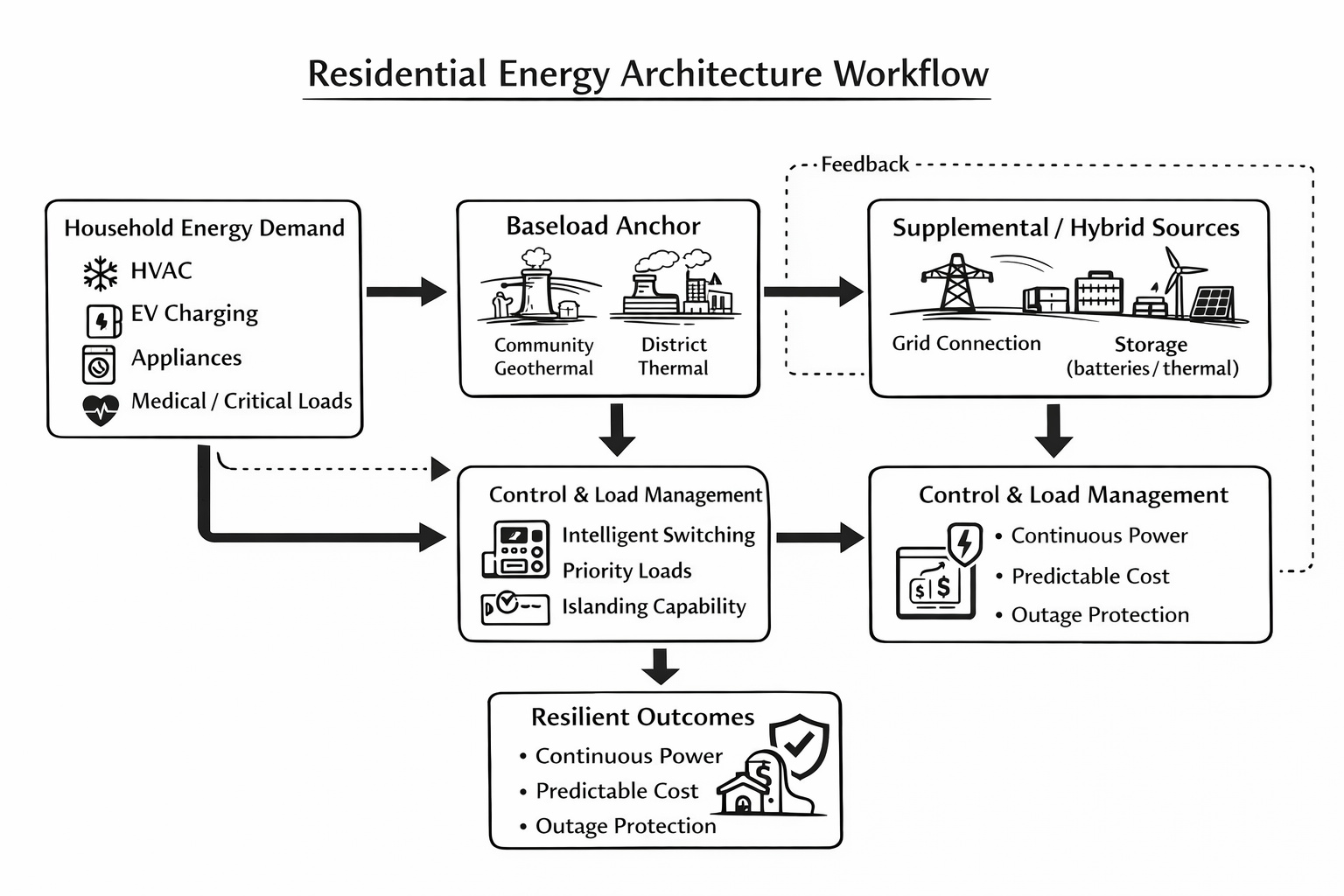
Residential energy security depends on how demand, baseload supply, hybrid resources, and control systems are architected together. The diagram below illustrates a practical, systems-based approach to residential energy resilience.
Key Principles of Residential Energy Security
Baseload First
Systems should ensure a reliable base level of power that is available irrespective of weather or fluctuating supply. This principle guards against the uncertainty of intermittent generation.
Hybrid Integration
Residential systems can combine baseload sources, storage, and system controls to meet both daily and emergency energy needs without compromising reliability.
Long-Term Cost Planning
Evaluating energy options should include cost behavior over decades – not just upfront installation costs – to protect households from unpredictable price swings.
Scalable and Resilient Architectures
Systems should be adaptable as needs evolve, whether for a single home, a neighborhood microgrid, or a community energy hub.
What Residential Energy Security Looks Like in Practice
Depending on geography, existing infrastructure, and household needs, residential energy security strategies might include:
Community Energy Microgrids
Shared infrastructure that can island from the central grid during stress events, ensuring extended uptime for critical services.
Distributed Baseload Anchors
Locally deployed, constant-output energy sources (e.g., community geothermal, district thermal networks) that reduce dependence on variable grid conditions.
Intelligent Backup Systems
Systems designed to seamlessly support mission-critical loads (HVAC, health devices, data connectivity) during outages.
Long-Haul Cost Optimization
Roadmaps that evaluate energy cost liabilities over time and prioritize options with predictable long-term costs.
Engedi’s Approach to Residential Energy Security
Engedi Solutions helps homeowners, community planners, and residential energy advocates think strategically about how power is delivered, consumed, and sustained:
-
Residential Energy Needs Assessment
Evaluate existing energy demand and reliability gaps in a household or community. -
Baseload and Hybrid Architecture Planning
Assess how baseload power sources and hybrid systems can serve residential continuity. -
Cost Over Time Evaluation
Model long-term cost outcomes for energy investments – factoring in volatility and reliability risk. -
Scenario Modeling and Roadmaps
Provide decision tools to compare options, including grid dependence, storage solutions, and distributed generation.
Engedi’s work is advisory, not installation – designed to guide decisions before major investments are made.
Why This Matters for Homeowners and Communities
Investing in residential energy security is not simply about technology. It’s about protecting safety, productivity, and economic stability in a world where energy demand is growing and tolerance for disruption is shrinking.
Reliable energy can mean:
-
uninterrupted work and connectivity
-
preserved food and medicine
-
reduced vulnerability in emergencies
-
predictable household budgeting
This is resilience in action – grounded in planning and strategic design.
Start Your Residential Energy Strategy
If you’re a homeowner, community planner, or residential stakeholder looking to assess your energy security needs and evaluate tomorrow’s options today, Engedi Solutions can help guide you through structured, defensible, long-term planning.
👉 Contact Engedi Solutions to begin your residential energy security assessment.