
Thorium: Promise, Limits, and Reality
Understanding Thorium’s Role in the Future of Energy
Thorium often appears in discussions about the future of nuclear energy with phrases such as “safer,” “abundant,” and “next-generation power.” These ideas reflect genuine science, but they also invite confusion – especially when this topic is used outside its technical context. To support knowledgeable decision-making, this article explains thorium’s promise, constraints, and realistic role in energy planning.
1. The Promise: Why Thorium Inspires Interest
Thorium is a naturally occurring element, more abundant in the Earth’s crust than uranium. It can serve as a nuclear fuel in certain reactor designs. The attributes that generate interest include:
Higher Natural Abundance
Thorium is approximately three to four times more abundant than uranium in the Earth’s crust. Some view this as a strategic advantage if thorium fuel cycles become commercially viable.
Potential for Reduced Long-Lived Waste
Under certain fuel cycles, the amount of long-lived transuranic waste may be lower than in traditional uranium reactors. This has led to speculation about easier long-term waste management.
Inherent Safety Features in Some Designs
Certain reactor concepts – such as molten salt reactors – can use thorium in ways that allow passive safety behavior (e.g., low operating pressure, negative temperature coefficients).
These features underpin the idea that thorium could play a role in future reactor systems that are both safer and more sustainable than some legacy designs.
2. The Reality: Technical and Commercial Constraints
While thorium has theoretical advantages, the practical deployment path has significant limitations that every energy planner and policymaker should understand.
A. Thorium Is Not a Stand-Alone Fuel
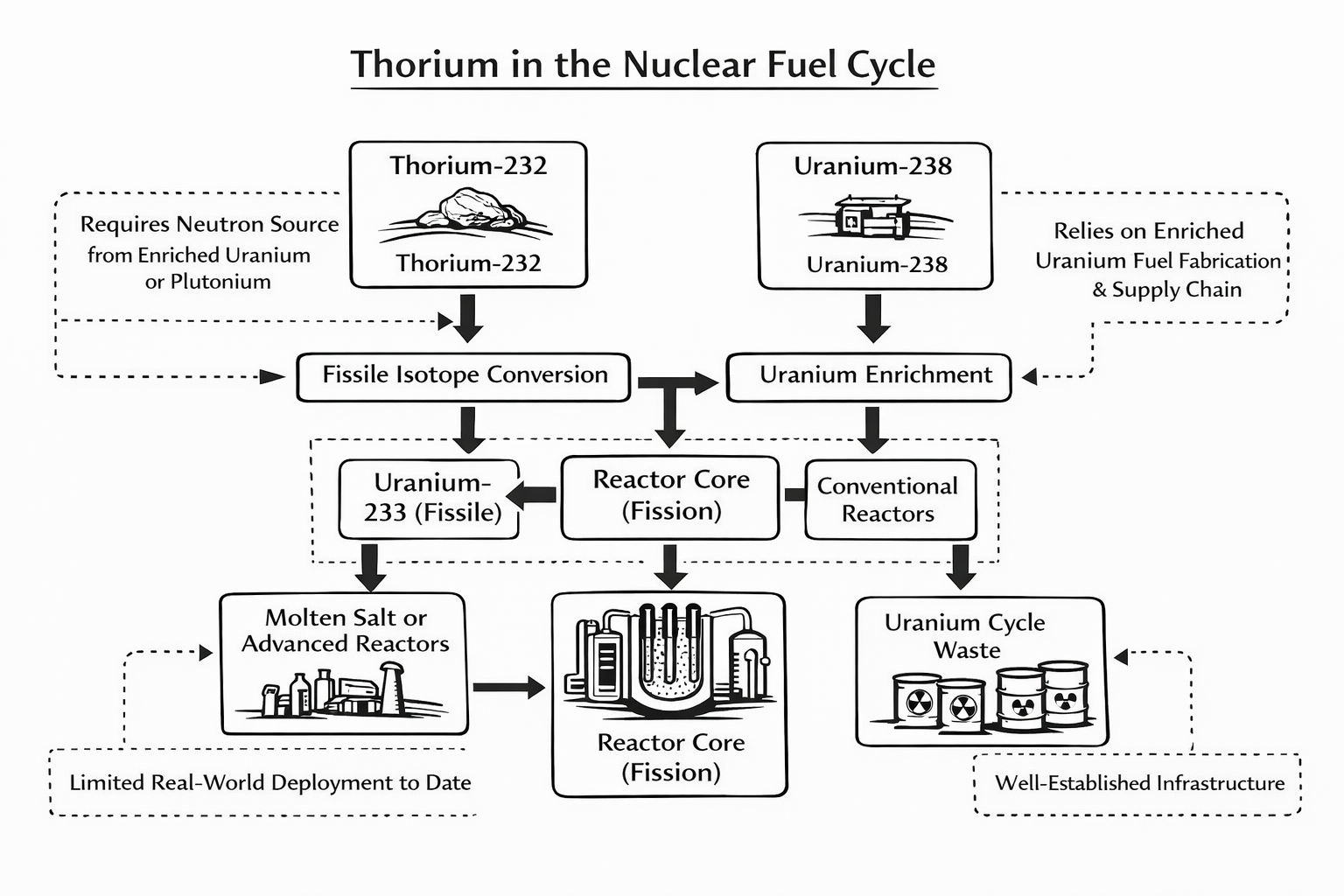
Thorium itself cannot sustain a nuclear chain reaction. It must first be converted to a fissile isotope – typically uranium-233 – through neutron absorption. This conversion requires an initial source of neutrons, often from enriched uranium or plutonium. Thus, thorium is part of a fuel cycle rather than a self-contained fuel.
B. Limited Commercial Experience
Thorium fuel cycles have been tested in research and demonstration reactors (e.g., India’s thorium research programs, molten salt reactor experiments), but they have not been widely deployed at commercial scale. Consequently:
-
engineering databases lack extensive operational data]
-
regulators do not have mature licensing frameworks specifically for thorium cycles
-
supply chains are not established at scale
This contrasts with uranium-based reactors, which benefit from decades of commercial deployment and regulatory evolution.
C. Molten Salt and Advanced Reactors Are Still Emerging
Many thorium concepts pair with advanced reactor technologies – such as molten salt reactors (MSRs) and high-temperature gas reactors. These designs are promising but are not yet commercially proven. They face:
-
materials challenges (e.g., corrosion in molten salt environments)
-
complex chemistry and fuel handling issues
-
regulatory and licensing uncertainty
Advancements are being made, but deployment timelines remain in the multi-decade range.
D. Waste and Proliferation Are Not Automatically Solved
While thorium cycles can reduce certain long-lived isotopes under specific conditions, they do not eliminate radioactive waste entirely. Some isotopes formed in thorium cycles still require management and containment over long timescales. Proliferation risks, while potentially different in detail from other fuel cycles, still exist and require robust safeguards.
The diagram below illustrates how thorium fits into the nuclear fuel cycle relative to conventional uranium reactors, highlighting both its promise and the additional complexity required for practical deployment.
3. Thorium versus Uranium: What Really Differs
| Feature | Uranium Fuel Cycle | Thorium Fuel Cycle |
|---|---|---|
| Commercial maturity | High (widely deployed) | Low (mostly experimental) |
| Fuel availability | Established supply chain | Abundant but not yet commercial |
| Waste profile | Known, regulated | Potentially fewer transuranics but still requires management |
| Licensing frameworks | Mature | Immature |
| Industrial ecosystem | Complete (fabrication, regulation, operation) | Partial |
This comparison helps distinguish future potential from current feasibility.
4. What This Means for Energy Planning Today
For organizations and regions considering long-term energy strategies, thorium should be evaluated as part of a technology landscape — not as an immediate replacement for existing baseload choices.
Near-Term Practical Options
-
Conventional nuclear (existing reactors)
-
Small modular reactors (SMRs) with established fuel cycles
-
Geothermal baseload systems
-
Hybrid baseload architectures with storage
These options have:
-
clearer regulatory pathways
-
established engineering experience
-
more predictable costs and timelines
Role of Thorium
Thorium is best viewed as a long-horizon consideration:
-
worthy of monitoring in research and policy contexts
-
potentially valuable as part of future advanced reactor deployments
-
a driver for continued innovation in nuclear chemistry and engineering
Energy planners should consider thorium’s research trajectory and regulatory development horizon when looking 10-30 years ahead – not as a plug-and-play solution today.
5. Realistic Futures: Where Thorium Might Fit
Thorium may gain relevance in scenarios such as:
-
Advanced reactor demonstrations in national research programs
-
Public-private deployments with extended regulatory cooperation
-
Supplementary fuel cycles integrated with other baseload sources
-
Long-term strategic diversification of nuclear fuels
In these contexts, thorium can be part of future energy portfolios evaluated at the planning stage, with the understanding that commercial readiness is not immediate.
6. Conclusion: Promise Backed by Pragmatism
Thorium has theoretical allure: abundance, potential safety features, and a different waste profile. Yet the commercial reality remains that thorium fuel cycles are not yet deployed at scale, lack mature regulatory frameworks, and require significant industrial development.
For energy strategists, this means:
Thorium is worth watching and understanding — but not a near-term cornerstone for baseload energy planning.
Engedi Solutions encourages planners to incorporate thorium’s potential into long-term scenario modeling while anchoring today’s strategies in technologies with clearer pathways to deployment, reliability, and cost predictability.